Transforming Africa’s Universities for Development: Reflections from the RUFORUM AGM 2025 and the Role of SUA
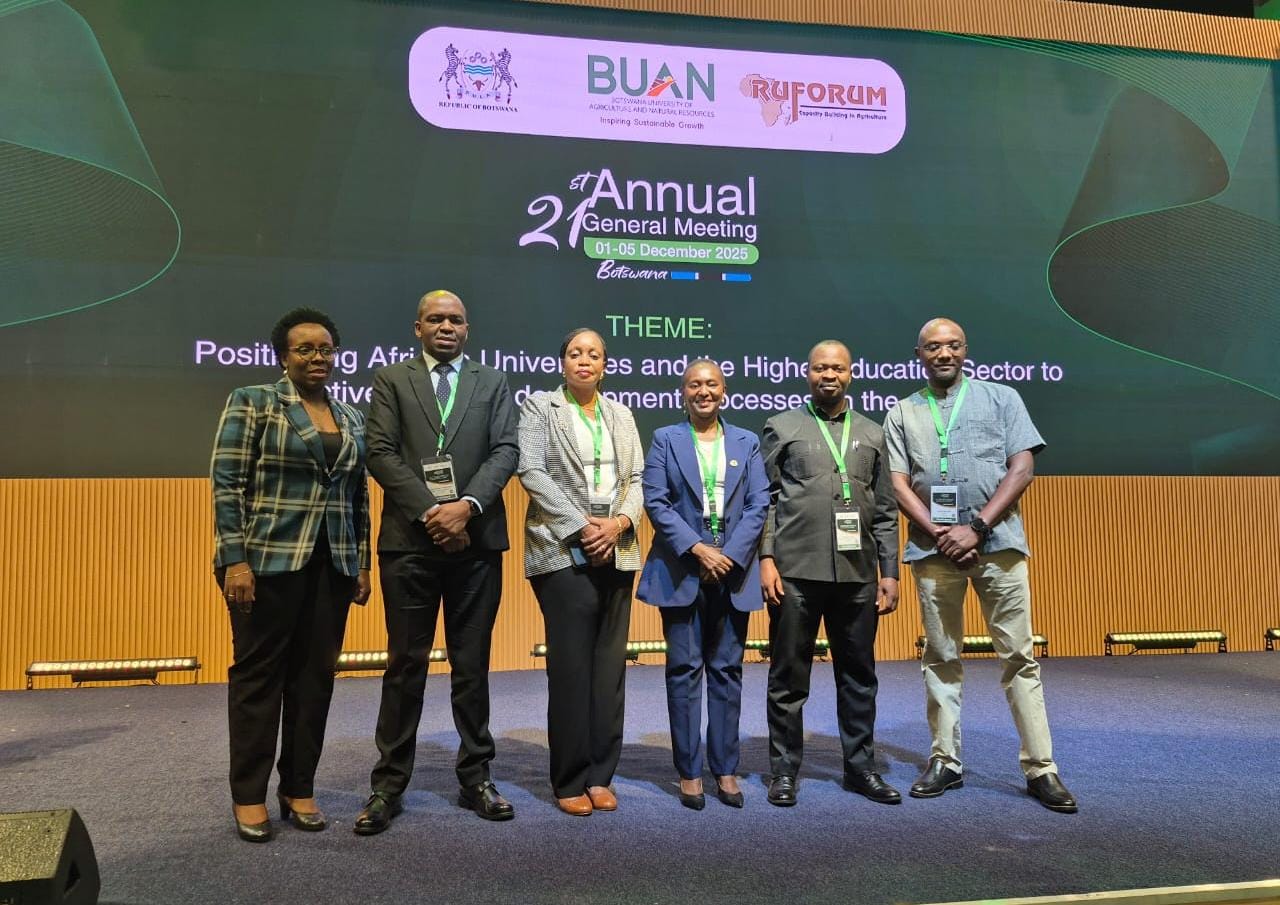
The 21st RUFORUM Annual General Meeting (AGM), held in Gaborone, Botswana, brought together universities, research institutions, governments, and development partners from across the continent to re-examine how Africa’s higher education sector can accelerate inclusive and sustainable development. Guided by the theme “Positioning Africa’s Universities and the Higher Education Sector to Effectively Impact Development Processes on the Continent,” the AGM emphasized the urgent need for 4th-generation universities—institutions that are innovation-driven, responsive to societal needs, and capable of producing graduates ready to thrive in dynamic labour markets.
Over several days, the AGM featured high-level dialogues, technical sessions, and strategic conversations focused on strengthening university systems, enhancing curricula, and promoting transformative teaching and learning.
Participants explored ways to integrate competence-based education, strengthen university–industry linkages, expand community engagement, and enhance research uptake to improve evidence-based decision-making.
Importantly, universities were urged to go beyond the traditional three pillars of teaching, research, and consultancy, and deliberately venture into developing products and services that directly transform livelihoods and contribute to the economic advancement of the societies they serve. This shift reflects the rising expectation for African universities to become engines of innovation, enterprise creation, and practical solutions to development challenges.
The AGM also underscored the need to strengthen innovation ecosystems, invest in agripreneurship development, embrace digital transformation, mainstream gender inclusion, and enhance accountability systems across institutions. Deliberations further highlighted the importance of aligning university mandates with national development priorities, embedding action research within postgraduate training, expanding agribusiness incubation for youth employment, and strengthening partnerships that build resilient food systems and climate-smart agriculture.
The meeting provided a rich platform for networking and capacity building. Participants gained practical skills in transformative leadership, safeguarding and gender responsiveness, strategic communication and visibility, monitoring and evaluation, and financial accountability—competencies that are increasingly essential for universities working to make measurable impact.
THE ROLE OF SUA AT THE AGM
In a session on transformative education and ecosystem engagement, Prof. Maulid Mwatawala, Deputy Vice Chancellor for Academic, Research and Consultancy (ARC) at Sokoine University of Agriculture (SUA), participated and delivered reflections and key takeaway messages.
He emphasised that transformative education is not a new concept for SUA; it is deeply rooted in the University’s founding philosophy.
He recalled that transformative learning was central to the 1984 inaugural speech delivered 45 years ago by Mwalimu Julius Kambarage Nyerere, the Father of the Nation of Tanzania and the first Chancellor of SUA, who stated:
“The major purpose of this University is the development and transmission of skills and practical expertise at the highest level. And the skills and expertise required are all those necessary and useful for the transformation of our rural areas.”
SUA participated alongside AGRIFOSE-RIH project partners from the University of Dar es Salaam (UDSM) and the Nelson Mandela African Institution of Science and Technology (NM-AIST). Representing the partnership were Dr. Hamisi Tindwa, Dr. Nyambilia Amuri, Dr. Nuria Majaliwa, Dr. Christopher Magomba, Prof. Kelvin Mtei, Dr. Leonard Binamungu, and Ms. Nasero Muse, reflecting the strength and diversity of the Tanzanian consortium in agri-food systems transformation, climate resilience, youth development, and capacity strengthening.
Together, the Tanzanian delegation shared progress from the Agri-Food Systems and Entrepreneurship Development in Rice and Horticulture Value Chain(s) in Tanzania (AGRIFOSE-RIH) initiative. Their contributions aligned with continental priorities on youth empowerment, value addition, entrepreneurship, climate-smart agriculture, and the broader transformation of food systems.
The AGM also provided the partnership with opportunities to deepen collaborations, strengthen networks, and build new capacities relevant to programme delivery. Lessons from Botswana reinforced their commitment to expanding action research in postgraduate training, scaling agripreneurship incubation models—such as SUA STEPS, SUA ACCESS, and SUA AIC—and extending AGRIFOSE-RIH interventions to out-of-school youth, displaced young people, and refugees.
Through this participation, SUA and its partners reaffirmed their dedication to supporting continental aspirations and contributing to “the Africa We Want”—an Africa driven by empowered youth, resilient agri-food systems, and knowledge-based development.